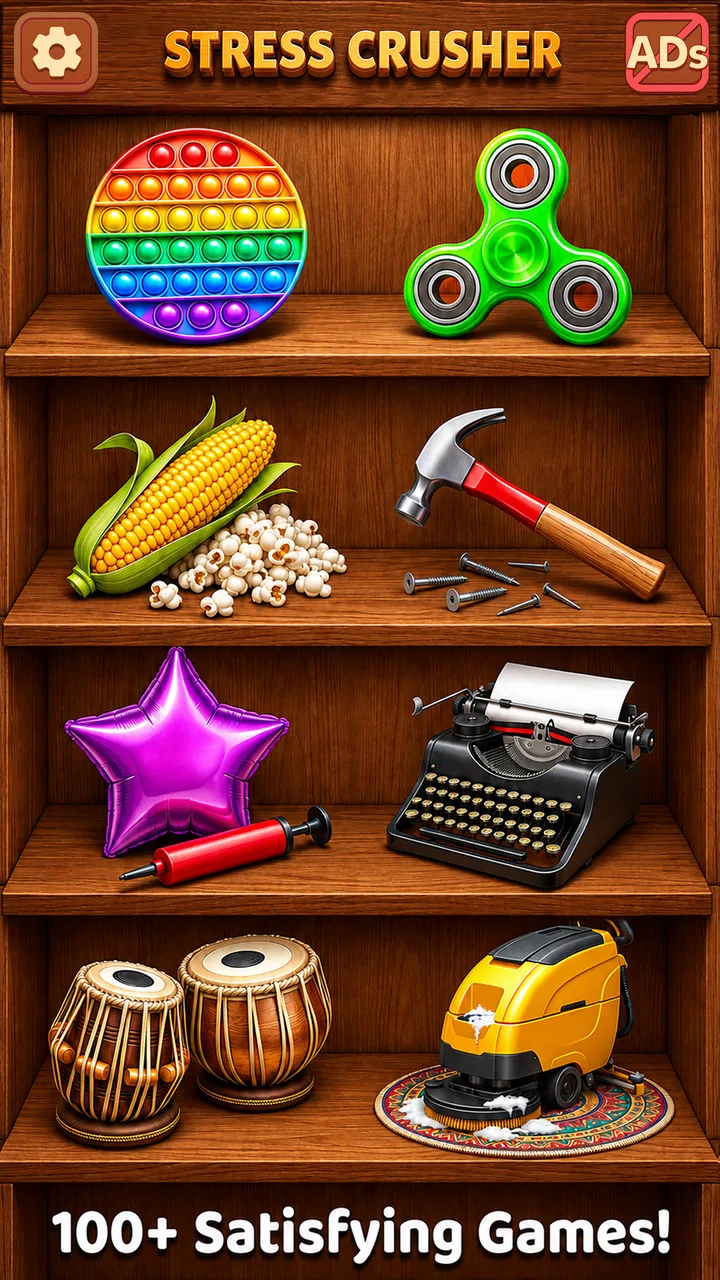
Stress Crusher Relaxing Games
- 4.5
- Rating
- 10.00M
- Installs
- Free
- Price
 Analysis by App-foxy
I approached Stress Crusher Relaxing Games expecting a light casual game for short breaks, and that is exactly where it makes the most sense. It is built around ASMR-style and fidget activities rather than a long story, complex strategy, or demanding competition. After spending time with it, I found the main appeal is the immediate feeling of doing something simple with my hands and attention. It is the kind of game I would open between tasks, while waiting for an appointment, or when I want a small distraction without committing to a full gaming session.
That simplicity is also the key to deciding whether it belongs on your phone. If you enjoy tactile interactions, repetitive actions, and calming mini-game routines, Mad1 Games has created something approachable. If you need deep progression, a strong narrative, or a carefully balanced competitive experience, this will probably feel too light. My opinion is generally positive, but it depends heavily on using it for what it is: a casual relaxation game, not a substitute for a serious puzzle game or a structured mindfulness tool.
What the game feels like in everyday use
The game sits in the casual category and is free to download. Its store summary focuses on soothing ASMR and fidget play, and that description matches the basic reason to try it: the individual activities are meant to be easy to understand and satisfying to repeat. I did not need a long learning period before getting into the central loop. That makes it friendly for someone who wants to play immediately rather than study instructions or build a complicated strategy.
You May Also Like

 Blood Strike: 2.5 Anniversary
Blood Strike’s Loadouts Turn Every Drop Into a Tactical Gamble
A close look at Blood Strike’s custom loadouts: how fast access to signature weapons reshapes its battle royale rhythm, rewards preparation, and narrows the gap between fights.

 Pandora - Music & Podcasts
Pandora’s Music Is Easy to Start, but Harder to Recover
Pandora’s strength is its low-effort path from a seed to a station. Its weak spot is how much confidence it asks you to place in connection, setup, and quiet recovery.

 8 Ball Pool
 Is Built on Rivalries, Rematches, and Routine
A close look at the rivalries, rematches, shared routines, and unanswered safety questions that turn a quick pool match into a persistent mobile community.

 Samsung Music
’s Quiet Strength Is Playing What You Already Own
Its reach comes less from spectacle than from dependable access to a personal library. That simplicity is both the app’s strongest retention engine and its ceiling.

 AccuWeather: Weather Radar
AccuWeather Review: A Quick, Clear Forecast for Everyday Decisions
For everyday plans, the best forecast is the one you can understand quickly. AccuWeather makes rain timing, radar, and local conditions easy to act on, with a few trade-offs.

 Hill Climb Racing
Why Hill Climb Racing Still Turns Crashes Into One More Run
A tiny car, a bumpy hill and one more upgrade: Hill Climb Racing keeps resurfacing because its simple chaos makes every near-miss feel personal.
More From Our News Desk



The best everyday scenario is a short pause when my attention is scattered. For example, after finishing a difficult piece of work, I might spend a few minutes interacting with a simple activity instead of opening a social feed and getting pulled into an endless stream of content. The game gives that pause a beginning and an end. I can play briefly, stop, and return to what I was doing without losing the thread of a campaign.
It also works well for people who like sensory feedback in games. The attraction is less about winning a major challenge and more about the small satisfaction of completing an action. That distinction matters. I would not recommend installing it because you expect a conventional arcade score chase. I would install it because repetitive, low-pressure interactions help you reset your focus for a moment.
The age guidance is Teen, so families should check whether that rating fits the intended player before installing it. The game is available on devices running Android 7.0 or later, which covers many older phones but still makes the operating-system requirement worth checking if you are using an aging device. The current version is 6.4, giving the app a fairly mature feel rather than that of a first experimental release.
How the free model affects the experience
The download is free, but in-app purchases are listed at $4.99 per item. That is the main spending detail I would consider before playing. A free entry point is useful for testing whether the style suits you, while the fixed price per item gives a clearer boundary than an entirely open-ended spending model. Still, I would not assume that paying is necessary or that it transforms the game into something fundamentally different. The sensible approach is to play without spending first and decide whether any optional purchase feels worthwhile.
For me, the important question is not simply whether the game costs nothing to start. It is whether the free experience remains comfortable when I ignore purchases. A casual relaxation game should not make me feel as if I must pay to enjoy a basic break. Since the listed purchase price is the only spending figure I can responsibly point to, I would treat every purchase as optional and avoid building expectations around specific unlocks or benefits that are not clearly explained in the app itself.
Parents and shared-device users should also remember that “free” does not mean purchases are impossible. I would use the device’s purchase controls if someone else can access the account, especially when a child or guest might play. That is a practical precaution, not a criticism unique to this title. The game is easier to recommend when the player decides in advance whether to spend and then sticks to that boundary.
Does it create pressure to keep playing?
The relaxing concept works best when I remain in control of the session. Short activities can be pleasant precisely because they do not demand much concentration. The downside is that a collection of small interactions can become repetitive if I play for too long. I noticed that the same strength that makes the game useful during a brief pause can become a weakness during an extended session: once the novelty fades, there may be less reason to continue.
That is why I would use it with a simple personal rule. I open it when I want a small reset, play until the activity stops feeling satisfying, and close it before the interaction turns into automatic tapping. This approach keeps the game connected to relaxation instead of turning it into another source of screen time. It is a surprisingly important distinction for a title whose entire identity is built around reducing pressure.
Players who enjoy collecting, unlocking, or steadily improving may want more visible long-term motivation than this style usually provides. I would choose a traditional puzzle game instead if my goal were to sharpen skills or beat a previous personal record. I would choose a story-driven casual game if I wanted emotional progression. Stress Crusher is better when the goal is immediate, low-effort engagement.
Fairness and the role of spending
This is not the kind of game I would judge mainly by competitive fairness. It is a personal, casual experience rather than a title that asks players to defeat one another or prove who has the strongest account. That removes one common concern with purchases: there is no reason for me to worry about another player buying an advantage over me in a contest.
Even so, spending can affect how fair the experience feels to an individual player. If optional items are presented prominently, some people may feel nudged to buy even when they only wanted a free relaxation tool. I would pay attention to whether the free activities remain enjoyable on their own. My recommendation is straightforward: do not purchase anything during the first session. Learn the rhythm of the game, decide whether you actually return to it, and only then consider an item priced at $4.99.
That trial-first approach is especially useful here because the game’s value is subjective. One person may enjoy the sensory actions for weeks, while another may lose interest quickly. A purchase cannot guarantee that the basic loop will become deeper. In my experience, the strongest reason to keep the game is how naturally it fits into spare moments, not the promise of building a large collection or competing on a leaderboard.
I also would not compare its purchase model directly with a competitive free-to-play game. In a competitive title, buying power can change the outcome of matches. Here, the more relevant question is whether an optional item improves personal comfort or variety. That makes the spending decision less about winning and more about whether the extra content justifies itself for your own routine.
Three practical ways I would use it
- Use it as a transition ritual. I would play for a few minutes after work or study, then put the phone down before starting the next task. The value comes from separating one activity from another, not from maximizing playtime.
- Choose it when concentration is low. When a demanding puzzle feels frustrating, this game offers a gentler alternative. It lets me interact with something without adding another problem to solve.
- Test it before spending. I would keep the first sessions completely free, notice which activities I return to, and only consider an in-app item if the game has already earned a regular place in my routine.
These uses reveal a trade-off that is easy to miss in a short store description. The game can be helpful because it asks little from me, but that also means it cannot replace an activity designed for measurable progress. It is a reset button, not a training program. I would avoid using it as my only response to serious stress, anxiety, or sleep problems; a casual game can provide a momentary distraction, but it is not professional care.
What it does better than familiar alternatives
Compared with a conventional puzzle game, this title has a lower barrier to entry. I do not need to remember a board state, plan several moves ahead, or accept failure as part of the experience. That makes it a better choice when I want comfort rather than challenge. Compared with a meditation app, it is more interactive and playful, but it is also less structured. Someone seeking guided breathing, timed sessions, or a formal relaxation routine would be better served by an app designed specifically for those purposes.
Compared with ordinary fidget toys, the game is more portable because it is already on the phone, and it can offer a wider range of interactions. The trade-off is that the screen itself can become distracting. A physical object may be better when I want to rest my eyes or step away from notifications. This is one situation where the digital format is convenient but not automatically superior.
Against endless scrolling, I find the game easier to contain. A social feed has an unpredictable stopping point, while a small casual activity feels more deliberate. That does not make it automatically healthy, but it gives me a better chance of taking a short break without being drawn into unrelated content. If I am already tired of screens, though, I would choose music, a walk, or a physical fidget object instead.
Who should install it, and who should skip it
I would recommend it to players who enjoy ASMR-inspired interactions, gentle fidget play, and short sessions with no complicated setup. It is also a reasonable option for someone who wants to try a free casual game before deciding whether the format is worth keeping. The large audience is reflected in its average rating of 4.4 from around 25 thousand ratings, while more than 10 million installs suggest that the concept has reached well beyond a small niche.
Those numbers tell me that the game has broad appeal, but they do not remove the need for personal judgment. A popular casual game can still feel repetitive to someone who needs constant novelty. I would skip it if I dislike touch-based repetition, if I want a substantial story, or if I expect every session to provide a meaningful challenge. I would also skip it when my main goal is a screen-free way to calm down.
It may suit a teenager or adult looking for a quick distraction, but the Teen content rating means I would not treat it as an automatic choice for younger children. I would check the device and account settings before handing over a phone, particularly because optional purchases are available. Those small precautions make the free trial more comfortable and prevent an accidental spending decision from becoming part of the experience.
Questions I would ask before downloading
Will it run on an older phone? Android 7.0 or later is required, so I would check the system information before trying to install it. If the device meets that requirement, the game is positioned as a lightweight casual option rather than something that demands a high-end gaming setup. I would still keep the app updated to the current version, 6.4, when possible, because compatibility and stability are easier to judge on the version the developer currently supports.
Do I need to pay to start? No. The game is free to download, and the listed in-app purchase price is $4.99 per item. I would begin without spending, especially because the central question is whether I enjoy the repetitive relaxation loop. Paying should be a later personal choice, not an assumption built into the first launch.
Is it suitable for competitive players? Not as a first choice. Its appeal is private, low-pressure play, so I would not download it expecting serious rankings, multiplayer rivalry, or a deep skill ladder. If competition is what keeps me interested, a dedicated arcade or puzzle game would probably provide a stronger reason to return.
Can it replace a mindfulness or stress-management app? I would not treat it that way. It can interrupt a tense moment and give my attention a softer target, which is useful, but it does not automatically provide a structured wellness method. For persistent stress, sleep difficulties, or anxiety, I would look beyond a casual game and choose appropriate support.
What should I watch for while playing? I would monitor whether the game is still calming or whether I am continuing out of habit. I would also decide my purchase limit before exploring optional items. That combination—short sessions and deliberate spending—keeps the experience aligned with its relaxing purpose.
My final trust verdict
Mad1 Games has made a focused casual game for a specific mood: the moment when I want something interactive, simple, and satisfying without a demanding objective. The free entry point makes it easy to test, and the listed purchase structure is clear enough for me to set a boundary before playing. Its broad reach, with over 10 million installs, supports the idea that this format works for many people, although popularity cannot predict whether its repetitive style will suit you.
My main reservation is longevity. The game is strongest in short bursts, and I would not expect it to deliver the depth of a puzzle campaign, the structure of a meditation program, or the excitement of a competitive game. The Teen rating and available purchases are also details I would keep in mind when sharing a device with younger players. None of these points rules it out; they simply define the conditions under which it makes sense.
My honest recommendation is to try it as a free, short-session stress break, not as your main game. If the ASMR and fidget interactions genuinely help you reset, it can earn a place on your phone. If you need lasting progression, measurable improvement, or screen-free relaxation, another option will serve you better. I would download it, play without purchasing anything at first, and keep it only if the experience leaves me feeling calmer rather than merely more occupied.
FAQs for Stress Crusher Relaxing Games
01What is Stress Crusher Relaxing Games?
Stress Crusher Relaxing Games is an app designed to help users unwind and de-stress through a variety of calming games and activities. The app offers a selection of puzzles, ambient sounds, and interactive experiences that aim to promote relaxation and mindfulness, making it an ideal tool for stress relief.
02Is Stress Crusher Relaxing Games free to use?
The app offers a free version with a selection of basic games and features. However, there are in-app purchases available that unlock additional content and premium features. Users can choose to upgrade to enhance their relaxation experience with more diverse games and customization options.
03What types of games are included in Stress Crusher Relaxing Games?
Stress Crusher Relaxing Games includes a variety of game types such as puzzles, calming visual interactions, and sound-based activities. These games are specifically designed to relax the mind, reduce anxiety, and provide a peaceful gaming experience that can be enjoyed at any time.
04Can Stress Crusher Relaxing Games be used offline?
Yes, many of the games and features in Stress Crusher Relaxing Games can be accessed offline, making it convenient for users to enjoy moments of relaxation without needing an internet connection. However, some features may require an initial download or updates when online.
05Is Stress Crusher Relaxing Games suitable for all ages?
The app is designed to be family-friendly and suitable for users of all ages. Its soothing games and simple interfaces make it accessible to both children and adults seeking relaxation. Parents can feel comfortable allowing their children to use the app, knowing it promotes a positive and calming experience.
Pros
- Visually soothing graphics enhance relaxation.
- Variety of games keeps the experience fresh.
- Easy-to-understand interface for all ages.
- No intrusive ads interrupt gameplay.
- Customizable settings to suit personal preferences.
Cons
- Limited free content without in-app purchases.
- Some games require a stable internet connection.
- May not appeal to those seeking high excitement.
- Occasional lag on older devices.
- Progress resets if app is uninstalled.

Stress Crusher Relaxing Games
Gallery